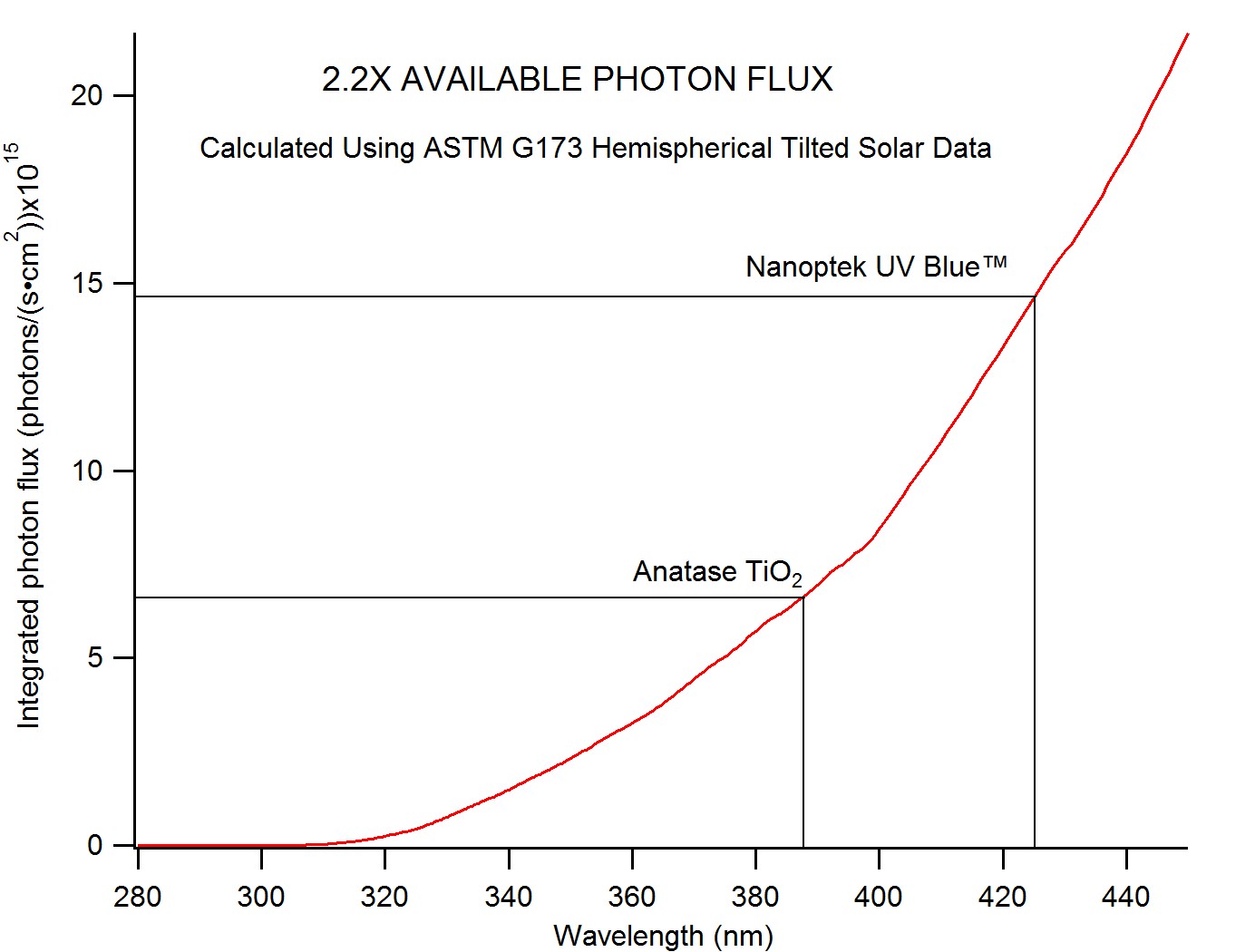
This is the same photocatalyst employed on the photoanode in our SHG300™ solar hydrogen generators. 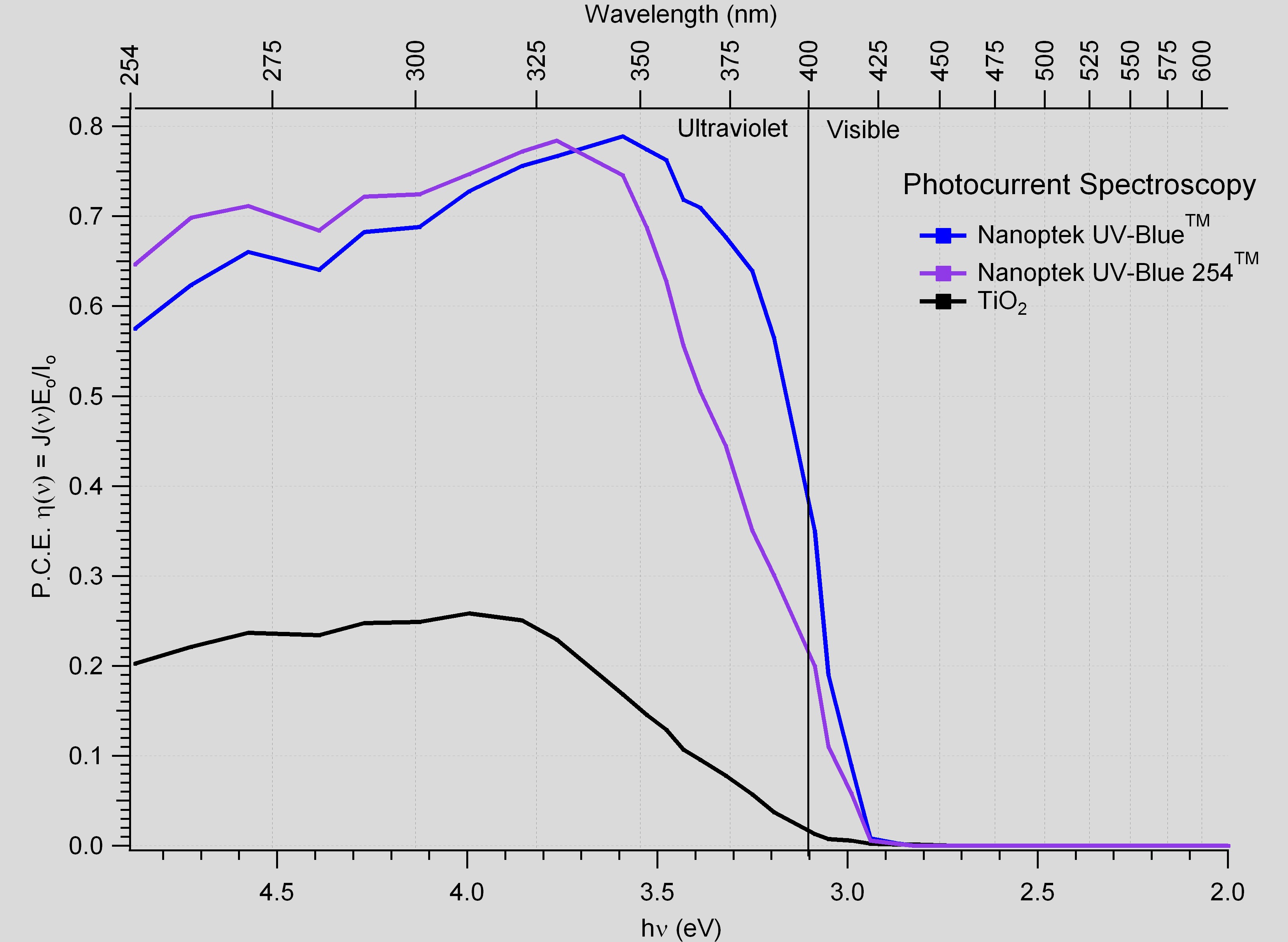 While its response to visible light is not as deep as with our Visible Light Titania™, the extra response that it has over anatase titania (left) occurs in a steeply rising part of the solar spectrum, such that over twice the solar photon flux is available for hydrogen production compared to anatase titania (click on the figure below left). Moreover, the photoconversion efficiency of our UV-Blue™ rises quickly to better than 80% at close to its bandedge (the figure at left includes Fresnel reflection losses), so that more of that extra photon flux is converted to hydrogen. This remarkable combination of a nearly square-wave photoconversion response and a doubling of available photon flux results in a photocurrent, indicative of hydrogen evolution, more than 10X better than titania.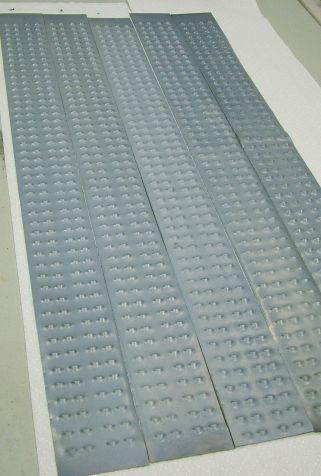
Unlike Nanoptek’s VLT™ powder, UV-Blue™ is a robust thick film that is formed onto and into a nano-structured titanium substrate. Our process is designed to work with, and in fact is enhanced by, the more economical “commercially pure” Grades 1 and 2 of titanium that are widely available as tubes, plates, or sheets.
We also produce UV-Blue 254™ that we tune for an improved response over UV-Blue™ at the 254 nm wavelength of germicidal lamps already in use in many water purification products and systems. Manufacturers, replace your current titania with our UV-Blue 254™ for improved effectiveness with lower electricity costs. Talk to us for free small sample coupons, or to purchase larger pieces for evaluation.
While others show centimeter-size samples, we produce our UV-Blue™ and UV-Blue 254™ photocatalyst by the square meter. The image at right shows several photoanodes that are 38 inches long and 3.125 inches wide, with louvers added for more efficient ion flow.
Further, the band edges of Nanoptek’s UV-Blue™ photocatalyst are engineered so that it operates at as much as 80% of its full photolytic capacity with no bias voltage at all, and even with losses inherent in scaled-up device implementations will reach its full capacity with as little as 0.75 VDC of overvoltage.